
The Paradox of Scale in Content Marketing
For years, the golden rule of content marketing was “Quality over Quantity.” However, in 2026, the arrival of ultra-advanced LLMs has shattered this trade-off. We have entered the era of The AI Content Factory. This is not about producing “spam.” It is about using sophisticated automation workflows to produce high-value, SEO-optimized, and fact-checked content at a scale that was previously impossible. For a business aiming for a 100-billion-won valuation, dominating the search results across thousands of keywords is the fastest way to build an impregnable digital moat.
The Anatomy of an Automated Content Pipeline
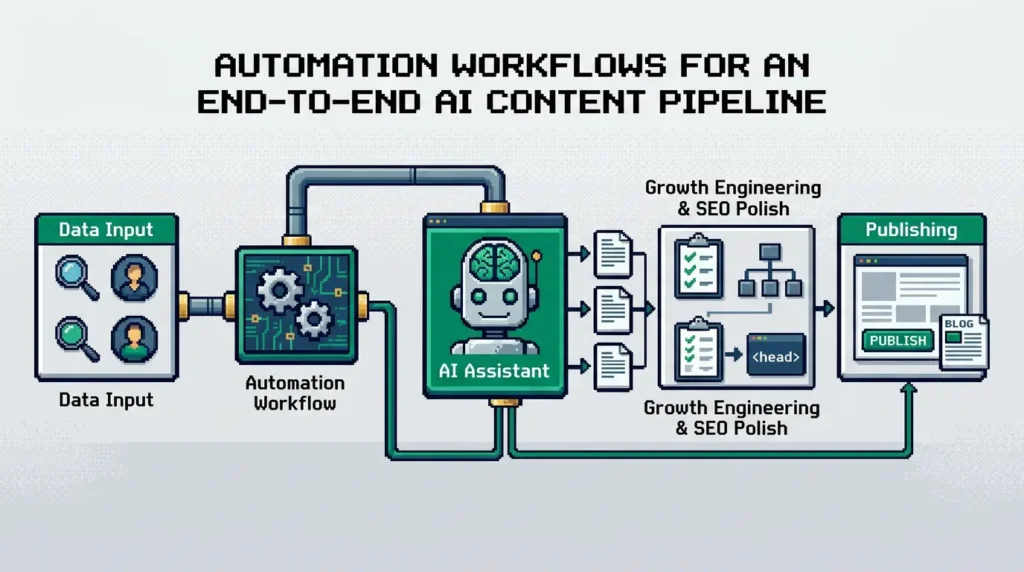
A true Content Factory doesn’t just “write” a post; it manages an entire lifecycle. To produce 100 posts a day with zero human effort, you need an integrated system consisting of four key stages:
-
Autonomous Keyword Discovery: Using Python scripts or Make.com modules, the system monitors Google Trends, Perplexity API, and competitor sites to identify “low-hanging fruit”—keywords with high intent but low competition.
-
Context-Rich Drafting: Instead of a simple prompt, the system “injects” real-time data into the AI. It scrapes the top 10 search results for a keyword, analyzes their structure, and instructs the AI (GPT-5 or Claude 4) to write a piece that is more comprehensive, better formatted, and more up-to-date.
-
Automated Media & SEO Optimization: The system automatically generates unique featured images using Midjourney API, adds Alt-text, creates internal links to your other posts, and optimizes meta-descriptions—all before the post ever hits your database.
-
Scheduled Deployment: Using the WordPress REST API, the factory pushes the completed posts into a queue, drip-feeding them throughout the day to maintain a natural publishing rhythm that search engines love.
Ensuring “Human-Level” Quality at Scale
The biggest fear with automation is the “AI-look”—content that feels repetitive or robotic. To avoid this, successful 2026 Content Factories use a Multi-Step Refinement Process. Instead of one AI writing the whole post, the task is broken down. One AI agent creates the outline, a second agent writes the sections, a third agent (a “Fact-Checker”) verifies the data against real-time web results, and a fourth agent (the “Editor”) polishes the tone to match your brand’s unique voice. This ensemble approach ensures that every single post meets a “Premium” standard, even when you are publishing at massive volumes.
The Economics of the Content Factory
The Return on Investment (ROI) of a Content Factory is exponential. While the initial setup of the API connections and Make.com scenarios requires time, the marginal cost of producing one additional post drops to nearly zero.
Imagine owning 1,000 high-ranking articles, each bringing in just 10 visitors a day. That is 10,000 daily visitors—an audience that costs thousands of dollars to acquire via paid ads, but costs you almost nothing to maintain. This is the power of owned media. By flooding the market with high-quality, automated information, you become the definitive authority in your niche, capturing massive AdSense and affiliate revenue.

Conclusion: From Blogger to Media Architect
In the age of AI, you must stop thinking like a writer and start thinking like a Media Architect. The goal is no longer to write the perfect sentence, but to design the perfect system that produces perfect sentences. The AI Content Factory is the engine that drives modern digital growth. By building this system today, you are creating a resilient, 24/7 revenue-generating asset that scales infinitely with the power of AI.
Related Posts

Mastering Business Automation: How to Build a Self-Running AI Empire in 2026
Mastering Business Automation: How to Build a Self-Running AI Empire…

Automating Customer Acquisition: Integrating AI Agents with Make.com
Beyond Chatbots: The Era of Autonomous Agents In 2026, the…

Decentralized AI: Why Personal Privacy is the New Luxury in the AI Era
Introduction: The Invisible Trade-off As AI becomes the backbone…