Mastering Chain-of-Thought Prompting is the most effective way to solve complex business logic in 2026
The Intelligence Gap: Response vs. Reasoning
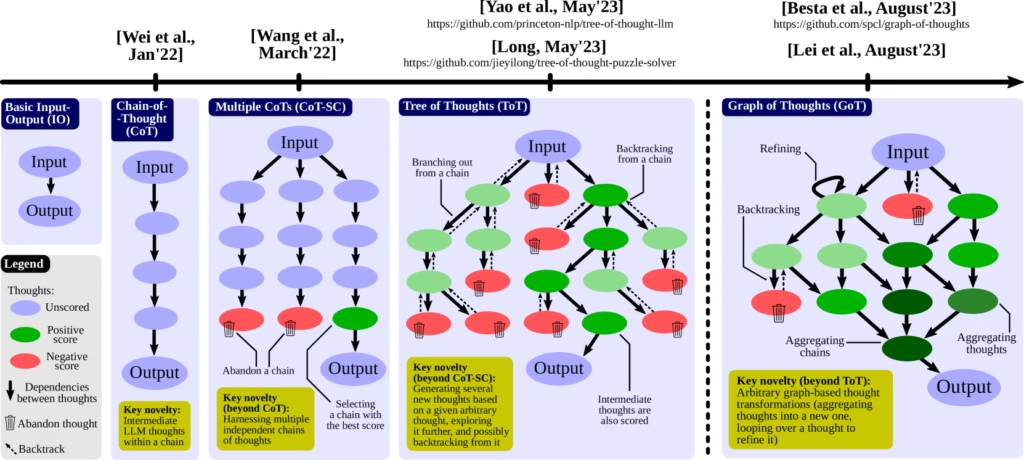
In the early days of LLMs, users were satisfied with quick answers. But as we move toward the 100-billion-won digital economy of 2026, “quick” is no longer enough. We need “correct” and “logical.” Many AI models fail at complex tasks because they try to predict the next word too quickly without a “thinking” process. This is where Chain-of-Thought (CoT) Prompting comes in. By forcing the AI to decompose a complex problem into intermediate logical steps, we can increase its reasoning accuracy by over 300% for mathematical, strategic, and creative tasks.
How CoT Works: The “Think Aloud” Protocol
The core principle of CoT Prompting is simple: Do not ask for the answer; ask for the process. Instead of a prompt like “What is the best marketing strategy for my SaaS?”, a CoT prompt would look like this:
“Let’s think step-by-step. First, analyze my current target audience. Second, identify their top three pain points. Third, propose a solution for each. Finally, synthesize these into a comprehensive marketing strategy.”
By providing this “logical bridge,” you prevent the AI from jumping to conclusions. This “Thinking Aloud” protocol allows the AI to use its internal attention mechanism to focus on each sub-task, ensuring that the final output is grounded in the logic of the previous steps. In 2026, this is known as “Reasoning-as-a-Service.”
Applying CoT to Business Automation
For a business architect, CoT is the secret to reliable automation. If you are using AI to make financial decisions or legal summaries, a single error can be catastrophic.
Financial Modeling: Ask the AI to list all assumptions before calculating ROI. If the assumptions are wrong, the final numbers will be wrong. CoT allows you to spot errors in the logic before they reach the result.
Conflict Resolution: When using AI to handle customer complaints, use CoT to let the AI analyze the customer’s emotional state first, then the factual issue, and finally the best empathetic response.
Strategic Planning: Use “Zero-Shot CoT” by simply adding the phrase “Let’s think step by step” to your prompts. This simple addition triggers the model’s latent reasoning capabilities, leading to much more sophisticated business plans.

The Evolution: Self-Consistency and Iterative CoT
Advanced prompt engineers in 2026 take CoT even further with Self-Consistency. This involves asking the AI to generate five different “Chains of Thought” for the same problem and then picking the most frequent or most logical answer among them.
This removes the randomness (hallucination) of AI and replaces it with a robust, democratic reasoning process. When your AI content factory or business agent uses Self-Consistency CoT, you are no longer just using a chatbot—you are operating a high-precision intelligence engine that rivals a human board of directors.
You can learn more about Prompt Engineering on OpenAI’s guide
Conclusion: Architecting the Future of Logic
The quality of your AI’s output is a direct reflection of the quality of your prompt’s logic. Chain-of-Thought Prompting is the ultimate tool for those who refuse to settle for the “average” response. As you scale your digital empire, remember that your greatest competitive advantage is not just having AI, but knowing how to make that AI think. Master the chain of thought, and you will master the complexity of the future. The era of the “Deep Thinker” AI has arrived, and it begins with how you frame the question.
For those interested in the academic origins of this technique, you can explore the official Google Research blog on Chain-of-Thought Prompting, which explains how large language models (LLMs) achieve reasoning capabilities.
Why Chain-of-Thought Prompting Matters in 2026
As AI models evolve, the difference between a simple response and a logical reasoning process becomes the key competitive advantage for businesses. Chain-of-Thought Prompting allows an LLM to mimic human cognitive processes, ensuring that each step of a calculation or strategic decision is double-checked for accuracy.
In the context of business automation, using Chain-of-Thought Prompting significantly reduces hallucinations—those annoying moments when AI confidently states a wrong fact. By breaking down tasks into smaller, manageable chunks, you can ensure your AI-powered workflows are robust, reliable, and ready for the 100-billion-won digital economy.
If you want to build a business with this logic, check out my guide on [AI-Powered Micro-SaaS].
Related Posts

Reverse Prompt Engineering: Stealing the Logic Behind Viral Content
[caption id="attachment_242" align="alignnone" width="800"] Reverse Prompt Engineering Content Analysis[/caption] The…
The “Context Injection” Framework: How to Get 10x Better Results from Any LLM
The Secret of Master Prompters Most people get average…
The Persona Protocol: How to Turn Any AI into a World-Class Expert (Full Guide)
The Problem: Why Your AI Output Feels Generic We live…